 RepolveGet the app
Your Strength Profile, explained.
Repolve’s Strength Profile turns eligible workout data into an understanding of strength across your body: muscle-level estimates, an overall Strength Score, and change over time.
What is a Strength Profile?
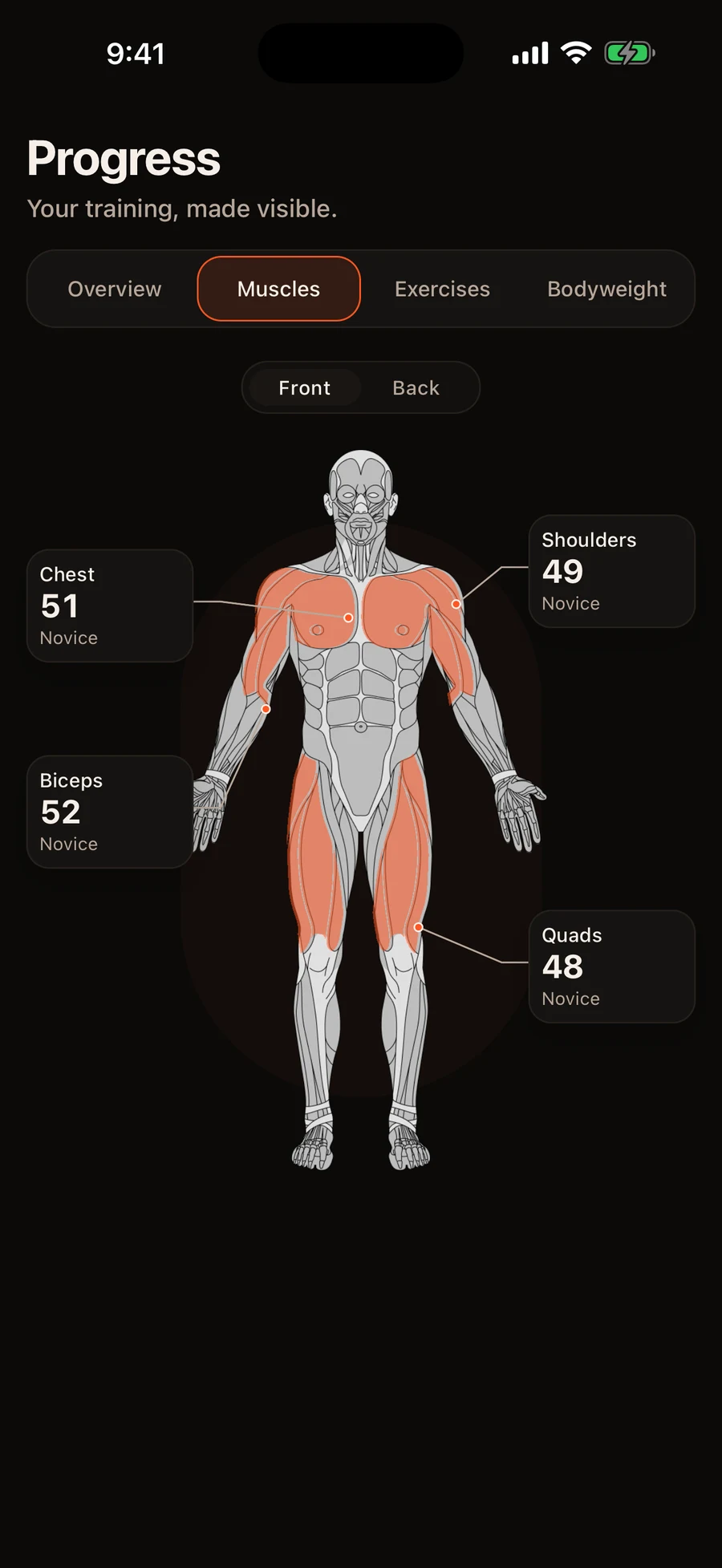
A Strength Profile is Repolve’s representation of your estimated strength, built from supported exercises you log. It combines muscle-level estimates, an overall Strength Score, and context about coverage and calibration. Its purpose is to help you understand what your training history means: which areas have evidence, how their estimates compare, and what is changing over time. The body map communicates that understanding; the underlying workout evidence makes it useful.
From a workout to your Strength Profile
- Logged sets, reps, and load
- Strongest eligible set per exercise and workout
- Exercise-level strength observations
- Muscle-level estimates
- Overall Strength Profile
- Changes across saved workouts
More logged sets can add training volume. They do not automatically establish a higher strength estimate. The evidence comes from eligible performance.
From workout data to strength understanding
The sequence is workout data → eligible strength evidence → exercise-level estimates → muscle-level strength → overall Strength Profile → progress over time. Not every logged set becomes strength evidence. Repolve checks exercise and set eligibility, then uses the strongest eligible set per exercise within each workout for its strength observation. For supported weighted lifts, estimated performance is compared with bodyweight-relative standards selected by sex.
A worked example: what a bench press set contributes
Consider an illustrative bench press set of 155 lb for 8 reps. The weighted-set formula estimates performance at about 196 lb for one rep. Bodyweight and sex are still needed to place that performance against the relevant standard. In Repolve’s scoring model, bench press provides primary evidence for chest. That observation informs the chest estimate; it does not independently establish scores for every muscle involved in pressing. One lift begins a profile rather than completing it.
Why more volume is not automatically more strength
A fourth set can add training volume while leaving the best demonstrated performance unchanged. Repolve therefore does not translate set count directly into a higher strength estimate. Training exposure describes the work you logged; eligible strength evidence describes supported performance. Repeated workouts still matter because they add observations and help establish the profile. Those are different reasons for a training history to be valuable.
The muscle map and the seven overall contributors
Repolve’s training model covers more muscle groups than the overall calculation. Seven groups currently contribute to the overall Strength Score: chest, shoulders, triceps, back, biceps, quads, and hamstrings. A muscle appearing in the training model or on the body map does not mean it has an established strength estimate or contributes to the overall score. That score requires evidence for at least three contributing groups.
An exercise can train more than it measures
Compound exercises involve several muscles, but Repolve assigns strength evidence through its exercise model. In the default calculator, bench press supplies primary evidence for chest, squat for quads, and deadlift for back. These assignments are scoring conventions, not complete anatomical descriptions. They prevent a single logged movement from being treated as independent proof of strength across every involved area.
Does a blank or lower muscle score mean a weakness?
A blank means there is not enough supported evidence to establish that estimate; it does not mean zero strength. A lower measured score is a starting point for investigation, not a diagnosis of an imbalance. Check the exercise history, setup consistency, and how much evidence has accumulated. The useful question is what explains the difference and what comparison would help you understand it better.
Read coverage, calibration, and change together
Coverage tells you which contributing muscle groups have evidence. Calibration reflects coverage and repeated qualifying workouts. Strength estimates describe performance within that evidence. As new areas become measured, the overall number may change even when earlier estimates stay the same. Reading these signals together helps distinguish a developing profile from a straightforward improvement in a familiar lift.
How to start your Strength Profile
Enter completed sets in the free calculator to see an initial exercise and muscle breakdown. Use supported exercises you have actually performed; do not invent values to fill missing areas. In the iPhone app, saved workouts connect that starting picture to subsequent training, exercise records, and progress over time. Personalized programming remains in development or testing; profile changes should not be read as a promise of automatic plan adaptation.
Choose how to track your training
A workout history, a muscle-volume chart, and a strength estimate answer different questions. Our comparison of workout tracking apps for strength training explains the differences and compares six apps by logging tools, programs, progress analytics, and price.
Keep exploring
About this guide
Written by Repolve to explain its own scoring model. This is first-party product documentation, not an independent review or a population study. Estimates describe logged performance; they do not directly measure muscle size or diagnose a training imbalance.